Business and Leadership Coaching | Clarity, values, follow-through
Author: Michele Roberts
Coach, Writer, and CPA. As a coach, I serve leaders who are interested in pursuing a career aligned with their values and a life marked with purpose and inner peace.
If you’ve been circling the idea of coaching — maybe even scrolling past my offers — but haven’t quite decided what kind of support you need, you’re not alone.
Some people come to coaching because they’re stuck in a loop they can’t get out of. Others know they want change, but the how feels overwhelming. And some are mid-freefall — holding a business, a life, a to-do list, and a little resentment that it’s all “technically working” but not really working.
Sound familiar?
That’s why I offer three levels of 1:1 coaching — each one designed to meet you where you are. Here’s a quick comparison to help you find the right fit.
Offer
Best For
Structure
Focus
🌿 Rooted & Rising
Deep, sustainable change in life, money, or business
12 sessions over 3–4 months
Clarity, follow-through, alignment
✨ Clarity Kickstart Series
Focused support for one specific goal or challenge
3 sessions over 4 weeks
Decision-making, short-term progress
⚡️ Momentum Session
A powerful single-session breakthrough
One 90-minute session + 1 week support
Fast clarity + next steps
You don’t need to have it all figured out to get support.
That’s literally the point.
You just need to be ready to show up for yourself — even if you’re not sure where to start. We’ll figure that part out together.
Starting a business takes courage, persistence, determination, and faith. Pat yourself on the back, entrepreneur. You’ve done it.
Entrepreneurship has excellent benefits — maybe you went into it to pursue your vision. To be your own boss. For a more flexible schedule.
And it can be hard work. As you seek to take your business to the next level, you may find yourself faced with one of the following questions.
Do you have so much to do you wish you could clone yourself?
Are you ready for growth but need to figure out what the next steps are?
You have a good understanding of business principles and specific goals. What’s preventing you from taking action?
One thing is true — we all need support. Starting a business is simple but not easy. For example, if you’re in professional services, you’re selling your intellect, which means that you can fulfill promises with the power of your mind and acquired skills.
This might make you feel chained to your desk, with scaling being next to impossible. But when you’re fulfilling customer orders as well as managing all of the other aspects of the business like sales, marketing, and billing, you know that you need to f. another way.
You recognize that you need to scale, but determining the best advice to take the business to the next level is challenging. Many people approach you with sales pitches promising to 10x your revenue, reduce your hours, or build a better lifestyle. So where do you start? Do you need a contractor, a consultant, or a coach, and what are the differences?
Extra Hands?
You can hire a contractor to share (or take over) some of the client work that you’re currently doing. They can manage some of the clients, and so can you. As you split the responsibilities, you can easily increase the number of clients you serve. If you hire the right person with ample expertise, you can confidently share your vision with them and trust them to execute while you simply follow up. It’s a quick path to growth. You cannot scale effectively if you are providing all of the client fulfillment.
But what are the downsides?
Taking on a less-experienced contractor doesn’t exactly double your work capacity as you will need to train and manage them and monitor administrative capabilities.
Taking on additional expense, especially for a well-qualified person.
Making sure that your vision stays intact without dilution.
How a Consultant Adds Value
A consultant can help you to define the process of scaling your business prior to your taking action. They can give you guidance and create a specific plan of action for you to follow. They can analyze the current state of your business, find issues to fix, and recommend specific corrective action.
By developing a roadmap and offering specific direction, the consultant can add significant value.
What are the cons?
Some consultants might have a one-size-fits-all approach to helping clients, and if their canned methodology doesn’t align with your style, it might not be easy to implement their recommendations.
Similarly, you could agree with their recommendations, but the requirements are arduous, and you don’t make time to take action on them. In this instance, it might be a good idea to employ a coach to help you to overcome the obstacles.
How can a coach help?
You’ve read all of the great books and know all of the principles to implement, but when you go to take action, something stalls.
You revert to your old narratives and fail to follow through on your good intentions. What gives?
This is where a coach comes in.
A coach can provide you with a customized approach to help you discover breakthroughs, develop new stories, and create new habits. With a coach, you will define and work toward specific agreed-upon goals and be held accountable.
Coaches recognize that you are the expert on yourself, and they are the expert on listening curiously, asking powerful questions, and providing insights that help you to challenge and question assumptions that may no longer be serving your growth.
An underlying assumption in the coaching space is that clients are more willing to implement solutions that they develop themselves, because they are bought into its effectiveness.
Coaching provides an objective sounding board to help spark ideas and identify patterns and resources so that you can together create the path to growth.
What are the cons of coaching? Coaching requires preparation and willingness to participate on the part of the client to explore alternative perspectives. It is not designed to assist a client who is seeking an advisor to provide direct answers.
The act of coaching develops the client more than it solves a specific business problem. As an extension of deep growth, the client might become more capable of, and adept at, finding solutions to their problems overall.
Coaching might not be the right course of action for someone who needs direct answers or is unwilling to focus within, although it could also help to find the best next resource.
As a business owner, finding the right support to help you scale will depend on what stage your business is in, your level of knowledge, and your willingness to change yourself. The good news is that there is support, and finding which is best for you is possible. By scaling, you become capable of carrying out your business vision and serving your own clients in a greater way.
It’s been said that there are two ways to tell what someone cares about — how they spend their time and how they spend their money. Sometimes, it feels like we’re in constant survival mode, scraping to make dollars in a race toward financial freedom. But what is financial freedom anyway? Freedom to do what?
This answer will vary from person to person depending on what they value most. Understanding these values is the foundation for establishing a mindset that can inform your goal setting and ultimately shift the outcomes.
It sounds simplistic, and it isn’t necessarily so, but with proper and regular exploration, it’s a worthy exercise to look within as a start toward goal setting and materialization of a custom-designed, fulfilling life.
What are values anyway?
The definition from Google provides the following:
a person’s principles or standards of behavior; one’s judgment of what is important in life.
Another way to consider this is to call it your “north star” or “guiding light.” It’s the “X” on the treasure map.
A start to clarifying your values
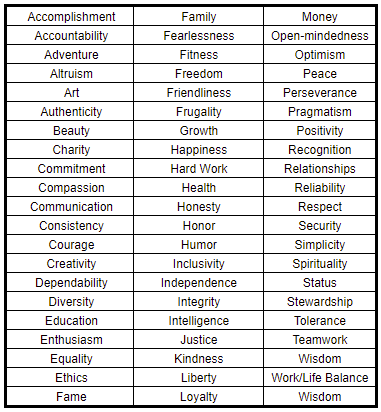
Consider reviewing the list below, and select words that resonate with you. This example is not exhaustive, but rather, it’s to provide a spark in your thinking. Feel free to add other words that identify what matters most to you.
Image provided by the author
Make a list of the value words that resonate with you. Then, sort the words into three to five groupings of like items. As an example, you might group integrity, honesty, and ethics together.
Choose one word from each group to indicate the most resonant or indicative of the group as a whole. Take some time to meditate on the groupings. Close your eyes and take a few deep breaths, reciting the words silently.
Know your values to guide your behaviors
Armed with three to five value words, begin each day reflecting on what these mean to you. As you face decisions, consider whether they are aligned with your value words.
Example 1: I value family. When I receive an offer to attend a dinner that falls at the same time as a special family event, I respectfully decline, and I feel good about having made a decision in alignment with my values.
When values conflict
What about when I value recognition and family?
Example 2: The boss invites me to present at a high-stakes event where I have the opportunity to connect with important people, but it conflicts with my child’s award ceremony or graduation?
Is this a simple scenario? It is if one value tips the scales heavily, but it’s not always so black and white. Exploration of the outcome can be useful in this scenario. Knowing how to communicate effectively might also. Finally, perhaps you might weigh the potential for future events. There are tradeoffs to every decision that you make.
In any case, this is where working with a coach who can thoughtfully provide space and insights for you to come up with a creative solution could be your best bet.
When boundaries are crossed
Having a good handle on your values is a great way to protect your boundaries. The elders of my day used to say, “If you don’t stand for something, you’ll fall for anything.”
It doesn’t mean that it’s easy, but when you know what guides you, you can make confident choices that shield you from giving in to the temptations and influence of others.
As we move through the days of our life, it’s easy to get lost in the clutter of our to-do lists. When you consider what’s on your list — right now — what criteria distinguish the yeses from the nos?
Clarifying your values might very well provide the answer to this question.
How to use seasonal transitions to prepare for life’s changes
What a difference a year makes. In Summer 2021, we returned to gatherings and vacations, and more activities with family and friends. Vaccinations brought a new sense of freedom, albeit with continued caution around the delta variant of COVID. As we round the corner into Fall, we can adopt strategies to manage the transition, take the time to reset, and look forward to the future with ease and flow. With a few simple strategies, you can welcome Autumn with enthusiasm.
Perhaps the end of Summer doesn’t mark a significant, traumatic transition for you, but it provides practice in the skill of managing change which can be applied to other transitions. In the business book, Managing Transitions (1991), William Bridges describes three phases of transition: Endings, The Neutral Zone, and New Beginnings. The book is a widely used management approach to managing change, but its concepts are applicable in everyday life.
Endings
All transitions begin with an ending. At the end of summer, acknowledge the things that you’ll miss: beach days, long bouts of daylight, outdoor activities, connecting with family and friends, vacations. If you’ve had a great time, take a moment to accept the sense of loss that comes with the inevitable change of the calendar. Fully experience the emotions that arise when you consider the change. Activities that can help with this include journaling, meditation, visualization, and gratitude work. The link between gratitude, joy, and well-being has been well documented, and what better way to commemorate the end of something special.
The Neutral Zone
Autumn “officially” begins on September 22nd this year, and during this “in-between” phase you might experience some mental fatigue as your brain works to readjust to new routines and external demands. During this time, create space to plan and re-evaluate your priorities. This is a great time to reconnect with your core values and become ruthless with what you allow to claim your time.
Sure, there might be real demands that warrant your attention, but don’t be afraid to deny others the right to define what’s important for you. If you need help clarifying your values, a life coach can be a great resource.
“And the sun took a step back, the leaves lulled themselves to sleep, and autumn was awakened.”
–Raquel Franco
New Beginnings
Looking strictly at the calendar, Autumn represents the beginning of the holiday season and the opportunity for making new memories. From choosing the next Halloween costume to planning a festive Thanksgiving feast, families get the opportunity to create lasting moments of togetherness and happiness. Take time to imagine the scene and take in the smells of the holidays.
Literature provides a great deal of context around the changing of seasons with metaphorical comparisons to the seasons of life. Autumn signifies maturity and ripeness, and it provides the opportunity for a reset and reevaluation of our goals and passions.
Autumn is a great time to review the resolutions that you set at the beginning of the year and fine-tune, change or abandon them. It’s a great time to resolve to finish the year strong.
Admittedly, as a California native, our seasonal shifts aren’t particularly dramatic, but I’ve always loved the long days of Summer. To me, there’s almost nothing better a sun that sets after 8:00 pm. After living through several summers, I’ve learned to embrace the joys and variety that comes with all of life’s seasons as opportunities to grow.
Transitions can be hard, but I can help you develop the right mindset and behaviors to make the most of them.
This week, I’m grateful for the opportunity to have participated in workshops through two incredible organizations focused on Justice, Equity, Diversity and Inclusion (JEDI) work.
The events hosted by both organizations — Coaches of Color & Culture and Trudi Lebron Coaching — allowed me the opportunity to meet other BIPOC coaches and allies who are actively engaged in the practice of shifting the field of coaching to increase representation and make coaching accessible to all communities, consider the impact and needs of BIPOC clients.
As we move further into 2021 and approach the one-year anniversary of the murder of George Floyd, we reflect on the last summer’s global protests of racism. Sadly, 2020 was not the beginning of injustice, and a lot more work needs to be done. We will continue to learn and contribute through our words and our deeds.
I love the fact that science and coaching work nicely together. In my opinion, understanding how the brain works is a key part of making lasting changes toward a life of greater significance.
Lately, I’ve been listening to the Huberman Lab podcast by Andrew Huberman, Ph.D. If you are up for learning in depth info on how the brain and nervous system work and how to use real science-based approaches to change in a positive way, you can find it on YouTube or your favorite podcast app. Dr. Huberman is a professor of neuroscience at Stanford, and each podcast is approximately 90 minutes of curated, solid information.
I was excited to discover this podcast because the science works nicely with the practice of coaching. In the first episode, Dr. Huberman explains the anatomy of the nervous system and the available functions, and in subsequent episodes, there are deep dives into different topics — such as sleep and neuroplasticity.
Neuroplasticity, explained in the simplest of terms, is the brain’s ability to change through growth and reorganization. Through the middle of the 20th century, it was widely believed that these changes were only available to children, but more recent research discovered the possibilities for changes in adult brains.
The benefit of failure
When we attempt to perform new tasks and fail, a couple of things happen. We experience frustration, and our brains produce a cocktail of chemicals or neurotransmitters. When adults repeat certain new actions in short durations (approximately 7 to 30 minutes), the neurons actually teach themselves. As you realize and acknowledge improvement, the brain releases dopamine, and the positive reinforcement helps motivate change.
Now here’s the fun part. Take a break. The neurons begin to reorganize during rest. You might have experienced this before. Imagine trying to learn a new piece on the piano, studying for an exam. You try and try and can’t get it, and then in the morning, voila. That’s neuroplasticity at work.
I recently completed all of the necessary education to qualify for certification through the International Coaching Federation and am taking the moment to bask in the congratulations messages of many friends and colleagues on social media.
Celebrating accomplishments is a great way to anchor positive neural experiences and to create positive memories upon which we can build confidence and self-encouragement. I am proud of the hard work that I put into completing this phase of the certification. It’s a symbol that marks a milestone in this continuing journey of service.
Life coaching is a profession for which no certification is required, and there are undoubtedly many life coaches who are competent without certification. For me, the education that I received was necessary. I walked into this profession knowing that I wanted to help people to pursue their purpose, and to grow as far as they can go.
Through the experience of training and in gaining actual working experience in the field, I have learned the discipline and skills necessary to facilitate a powerful coaching experience and assist my clients in making the shifts toward the life they desire using proven and tested methods in the field of coaching.
While intuition is a gift that serves the coach well, in my opinion, intuition alone is not enough. It’s sort of like trusting someone with mechanical intuition to help build your house.
So, I share this accomplishment proudly and look forward to continued service and facilitating powerful shifts and changes in your lives.
One of the factors to examine while considering coaching is how you can make the most of your coaching relationship. The coach is your thinking partner, someone who works with you to unfold your desired journey. As you build this partnership, both the coach and you must agree to be fully present and engaged in each session and commit to working together. As you seek to grow, you must fully accept the role of the client and commit to being coachable.
What is the role of the client?
In the coaching conversation, your coach will observe your words and mannerisms, and reflect what we see and hear. We might summarize and confirm or ask a question to challenge or broaden your perspective.
The client’s role is to ponder, engage and (prepare to) stretch.
Ponder
Take time to engage the questions or statements posed by your coach. Do you recognize a pattern within yourself? Is what the coach asking aligned with your values? Your desired goals? Does it upset you? As you allow the question to sink in, you’re ready for the next step.
Engage
You don’t have to know the answer. Accept the reflection and participate. Even if the best you can do is to say, “I don’t understand what you mean,” you’re giving your coach feedback to move the session forward. Be present and accept that the coach is there for your benefit, to engage in a non-judgmental, curious conversation.
Stretch
Be willing to challenge yourself. Usually, a client enters into a coaching relationship because they desire a transformative experience. This means being open to new thoughts or actions. It might mean challenging your current way of thinking or changing your thoughts and behaviors to attain the results that you seek.
Maybe the answer to your transformation is a matter of daring to doing one thing slightly different. Perhaps, it’s the courage to reach out to someone for support. Be prepared to consider options that might be outside of your comfort zone.
The Coachable Commitment
If you can commit to engaging in the relationship, then you can be coached. Show up ready to engage and expand. That’s it. You’re coachable.
When we start working together, I think it’s important for us to walk through what a coaching session will look like and have a clear understanding of the coaching relationship. Having worked with business coaches in the past, I never had anyone break this down, nor explain how a coach differed from a consultant (or even a teacher or therapist for that matter).
With this knowledge, the expectations of the coach and the client will be best defined to foster better outcomes as well as inputs.
My number one goal is for you to reach yours.
As your coach, my job is to bring out the best in you and provide insight only where appropriate. You are a powerful, whole, creative and resourceful leader with access to answers when you look within. A large part of my job is to listen closely, and to ask powerful questions.
During a coaching session, we will establish a goal that we’re working towards, and I will listen curiously, and ask a TON of questions designed to help you think, dig deep, shift perspectives, and push beyond your internal limiting beliefs, identify self-sabotaging tendencies, and envision and design a path success as you define it.
I have to admit that when I began my training, I was puzzled by this? I asked, “So we just ask questions?”
The answer to this is “no.” We don’t just ask questions, although we do ask a LOT of questions.
As you explore the answers, I will observe and follow you, listening in the moment for the best direction to propel you forward. Sometimes, I’ll bring the heat. It’s all in the name of you finding the fullness of yourself and reaching beyond. In this, you journey to where you will do your best work, leave your mark on the world, and live your best life.
Some of these questions will be hard to answer. Some are open-ended and allow you to find creative solutions to ordinary challenges. Some might push beyond your comfort zone. At any time, you are free to pass on questions; you drive the coaching session in the direction that is best for you.
We’ll discuss the resources that you will need and who or what can support you. We’ll define measures of accountability to keep you on track. Finally, once you feel that we have reached the goal for the current session, we will close for the day. You might have homework between sessions, or you might leave with insight to inform your next move in support of your longer term objectives.
Finally, you will leave the session with a well-defined action step or a powerful mindset shift. Over time, through the coaching relationship you’ll develop new habits, understand yourself better, push through those invisible yet palpable limits and even begin to form powerful self-questions.
It is my hope that demystifying the coaching process leads my clients to participate more fully in their transformations and that it fosters more buy-in to the co-creation of fantastic outcomes. I fully believe in the fullness of my clients and am thrilled to work in tandem with such powerful people as they broaden their impact on the world around them.
Schedule a call with me and take the next step toward loving what you do.
When I entered college, I had no idea what to declare as a major. My parents were of “The Greatest Generation” and were believers in choosing something that would provide a stable income and lifestyle. When all was said and done, I majored in and received my B.S. in Accounting from the University of Southern California. I worked in one of the world’s largest accounting firms, then in corporate America, and ultimately started my own practice in 2012.
Accounting has been a noble pursuit, and I’ve done some meaningful work and met amazing people along the way. Yet, my yearning to impact people in a more personal way and to have a more direct connection to social causes has led me to also pursue a career in coaching.
As a life coach, I take a holistic approach to helping people get to the bottom of what drives and motivates them and to understand their purpose. At the heart, I strongly believe that each of us is called on to share our unique gifts and can contribute to making the world a better place.
Whether you will reach millions from the stage or touch one person in an intimate conversation, your difference matters. As a coach, I help socially conscious people to amplify their voices and encourage you to follow your heart to inspire and motivate others. Together, we can co-create an exponential positive effect in the world.
Some might call me an idealist, and that’s okay. Those who follow their inner compass experience a peace known with doing their part to make the world a little bit better each day.